



FEDPOLEL 2ND REGISTRY RETREAT: EXPERTS HARP ON PROFESSIONAL EXCELLENCE, DIGITAL COMPETENCE AS MEMBERS APPRECIATE OUTGOING REGISTRAR AWE
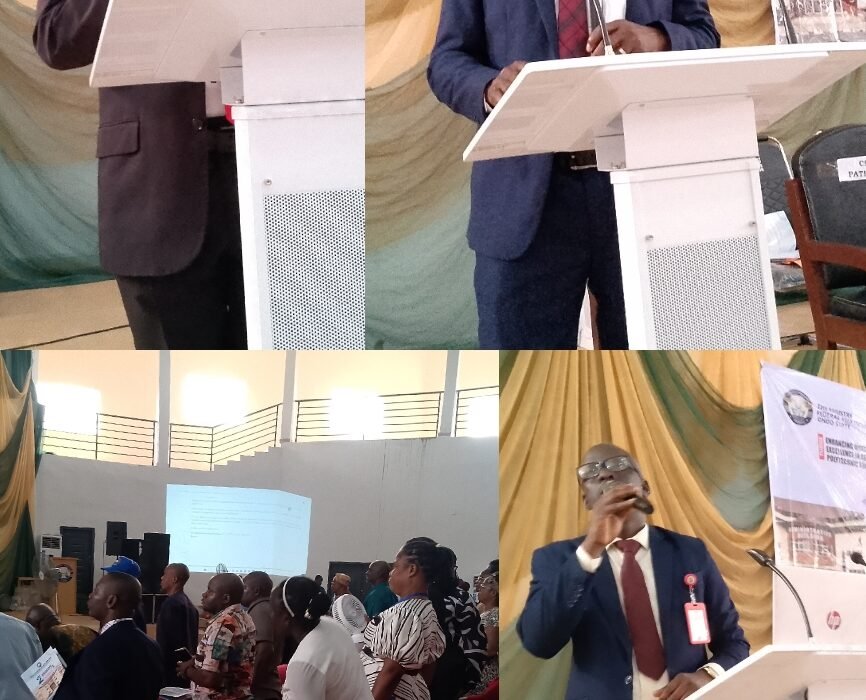
The future of Registry administration in Nigerian polytechnics may depend less on the volume of paperwork handled by officers and more on how effectively they combine digital competence with professional ethics, accurate records management and responsible use of technology.
This formed the central message at the 2nd Registry Retreat of the Federal Polytechnic, Ile-Oluji FEDPOLEL, Ondo State, where experts, administrators and Registry professionals examined the changing demands of tertiary education administration and called for a deliberate shift from traditional bureaucratic practices to digitally driven and professionally excellent Registry operations.
The retreat, held at the institution’s 1,500-capacity Multipurpose Auditorium, was themed, “Enhancing Digital Skills and Professional Excellence in Registry Practice for Polytechnic Education in the 21st Century.”

Four major lectures at the retreat focused on different but interconnected aspects of modern Registry practice: ICT Tools for Registry Efficiency; Modern Registry in Polytechnic Education; Student Records and Registry Operations; and Ethics, Confidentiality and Professional Conduct in Public Service.
The experts, in their separate presentations, stressed that digitalisation could improve the speed, security and efficiency of Registry operations, but warned that technology without competent, ethical and adaptable personnel could not deliver the desired transformation.
ICT TOOLS CAN TRANSFORM REGISTRY OPERATIONS
Speaking on “ICT Tools for Registry Efficiency,” the guest lecturer, Dr Popoola Oluseye, highlighted the importance of technology in strengthening Registry operations and improving the overall effectiveness of tertiary institutions.
Oluseye identified Registry efficiency as critical to increased student enrolment, successful accreditation of academic programmes, improved relationships with government agencies, secure preservation of staff, student and institutional records, as well as better institutional ratings by regulatory bodies.
He explained that the application of ICT tools could lead to faster completion of tasks, enhanced security of records and information and savings in office space through the electronic storage of files and other documents.
His presentation underscored the growing need for Registry personnel to understand and effectively deploy digital tools as institutions generate increasing volumes of administrative and student information.
‘MODERN REGISTRY MUST PRESERVE ITS ETHOS’
The second lecture, “Modern Registry in Polytechnic Education,” was delivered by the outgoing Registrar of the Polytechnic, Mr Gabriel Awe.
Awe described the administrative machinery of a tertiary institution as its engine room, noting that although it was often the least visible of the three major pillars of higher education institutions — academic delivery, physical infrastructure and administrative machinery— it remained central to governance and institutional continuity.
According to him, the administrative machinery is the custodian of institutional memory and the hub around which administrative processes ultimately run.
He said the Registry was at the centre of that machinery.

“It is the one that turns admission into a lived experience, teaching into certified achievement, and governance decisions into implemented action.”
Awe explained that a modern digital Registry was one in which traditional custodial and secretarial functions were performed with the deliberate support of Information and Communication Technology while retaining the discretion, accuracy and accountability that had traditionally defined the profession.
He said, “Modernity here is not about abandoning the ethos of the Registry; it is about carrying that ethos into a new operating environment.”

The outgoing Registrar identified faster turnaround in admissions and results processing, reduced duplication and loss of records, easier retrieval of historical data for accreditation visits by the National Board for Technical Education and greater transparency in governance processes as some of the gains of digitalisation.
However, he identified inadequate ICT infrastructure, unstable power supply, persistent skills gaps among Registry personnel, weak records-management culture, confidentiality risks, generational and cultural friction, weak professional regulation and funding constraints as some of the challenges confronting Registry practice in Nigerian polytechnics.
Awe recommended that institutions conduct digital-skills audits of Registry personnel and establish structured mentorship schemes, while providing continuing professional development in ICT, records management and administrative ethics.
He also called for written and enforceable policies on confidentiality and data protection aligned with the Nigeria Data Protection Act, 2023.
The outgoing Registrar further urged managements of polytechnics to prioritise investment in stable ICT infrastructure and power backup for Registry operations.
He said, “Going digital is a process and was my vision when I assumed office. We should have gone beyond this, if encouraged, but the management must understand its benefits and know it can work by being deliberate, provide mentorship, budget, and key into it.”
‘ACCURATE RECORDS PROTECT STUDENTS, INSTITUTION’

The third lecture, “Student Records and Registry Operations,” was delivered by the Deputy Registrar, Division of Academic Affairs, Mr Oluyemi Bamidele Adebiyi.
Adebiyi described student records management as fundamental to effective institutional administration and the continued growth of the Polytechnic.
He said the quality of Registry services depended on accurate information, organised records, confidentiality, ethical conduct, secure technology, effective procedures and competent personnel.
Adebiyi urged the institution to combine sound records-management principles with appropriate digital tools, particularly as the volume of student information continued to increase.
He said:n“Effective records management protects the interests of students while strengthening the credibility, efficiency and administrative capacity of the institution.”
His presentation placed student records at the heart of institutional accountability, stressing that the adoption of digital systems must go hand in hand with accuracy, security and professional responsibility.
ETHICS, CONFIDENTIALITY ESSENTIAL TO PUBLIC SERVICE

The fourth lecture, “Ethics, Confidentiality and Professional Conduct in Public Service,” was delivered by the Deputy Registrar and Head of the Division of General Administration and Council Affairs, Mr Rasaq Adebayo.
Adebayo emphasised the importance of sound work ethics and confidentiality, particularly in the handling of personal information and official records.
He said the progress of any organisation depended largely on the ethical values, trust, accuracy and level of confidentiality demonstrated by its workforce.
He outlined the 20 “Be’s” of work ethics, urging staff to be punctual, regular at work, interested in their jobs, enthusiastic, hardworking, honest, trustworthy, willing to learn and ask questions, safety-conscious, loyal, responsible and committed to teamwork.
He also urged workers to contribute suggestions towards improving their organisations, take responsibility for assigned duties, pursue continuous improvement, do things right the first time, learn from others, make responsible choices and regularly evaluate themselves.
Adebayo further identified honesty, accountability, integrity and humility as essential ethical values that should be imbibed by public servants.
‘TECHNOLOGY ALONE CANNOT DELIVER EXCELLENCE’
The Head of Service of Ondo State, Chief Segun Odusanya, who delivered the keynote address, reinforced the experts’ position on the need for digital competence backed by professional excellence.
Odusanya said the Fourth Industrial Revolution had transformed virtually every aspect of human endeavour, including governance, education, commerce, healthcare and public administration.
He warned that institutions that failed to embrace digital transformation risked becoming less effective and increasingly disconnected from the demands of a competitive global environment.
He described the Registry as the administrative backbone of every tertiary institution, responsible for maintaining institutional records, implementing policies, coordinating academic processes, facilitating governance and ensuring compliance with statutory and regulatory requirements.
He noted that “Technology alone cannot deliver excellence. The true value of digital transformation lies in the competence, adaptability and commitment of the people who operate these systems.”
The Head of Service urged the Polytechnic management to continue investing in staff development, digital infrastructure, robust information technology systems and modern Registry equipment.
He said the future of higher education administration belonged to institutions whose workforce combined digital competence with professional excellence, innovation, integrity and a genuine passion for service.
DIGITAL TRANSFORMATION NO LONGER OPTIONAL

Earlier, the Rector of the Polytechnic, Dr Ademola Ebeloku, described digital transformation as no longer optional but imperative.
Ebeloku said the Polytechnic’s ability to remain competitive, efficient and responsive would depend significantly on how effectively technology was integrated into its administrative processes.
He argued that a truly digital administrative culture must go beyond the use of computers for routine documentation.
“The traditional approach to Registry Practice is no longer sufficient,” the Rector said, adding that digitalisation provided an opportunity to reduce unnecessary bureaucracy and improve efficiency in institutional administration.
He, however, stressed that technology must be accompanied by integrity, discipline, commitment, confidentiality and courtesy.
“Technology is only as effective as the people who use it,”
Ebeloku said, urging Registry personnel to combine digital competence with professionalism and ethical conduct.
He also called for vigilance in the handling of digital information, stressing the need to protect institutional records against unauthorised access, loss, manipulation and misuse.
According to him, “Institutional records are valuable assets and their protection must remain a collective responsibility.”
The Rector also commended the outgoing Registrar for introducing the e-appraisal system for the Annual Appraisal Evaluation Exercise, noting that the initiative had reduced the burden and cost associated with contracting the production of appraisal forms.
Read More About FEDPOLEL Registrar Awe
MEMBERS HONOUR OUTGOING REGISTRAR

Beyond the technical sessions, the retreat also provided an opportunity for the Polytechnic community to appreciate the outgoing Registrar, Mr Gabriel Awe, for his leadership and contribution to the institution.
Awe, who used the occasion to appreciate dignitaries and Registry staff, also presented Awards to personnel in recognition of diligence and professional competence.
About six outstanding Registry workers received cash prizes as a form of recognition and motivation for their commitment to duty.

In a reciprocal gesture, heads of divisions in the Registry Department presented a gift to the outgoing Registrar in appreciation of what they described as his selfless leadership and impactful service.
The gift was described by the committee members as “something digital in nature,” with the members urging Awe to remain digitalised even after retirement.
The Rector, while appreciating Awe’s cooperation since he assumed office in 2023, also assured him that the Registry Annual Lecture would continue after his departure.

“Though this will be the last Registry Annual Lecture you will be presiding over as the Registrar of this great citadel of learning, let me assure you that this will not be the last Registry Annual Lecture; it has come to stay,” Ebeloku said.
The retreat thus ended with a common message from the speakers: that the modern Registry must not only become digital but must also remain professional, ethical, secure, accurate and responsive to the changing demands of tertiary education administration.
Watch the highlights of the event