
“POLITICS IS AN INVESTMENT IN NIGERIA; UNTIL WE CHANGE THE NARRATIVE, FORGET TRANSPARENCY”— KSO BLASTS CHRISTIANS’ NONCHALANT ATTITUDE TO ELECTORAL REFORMS
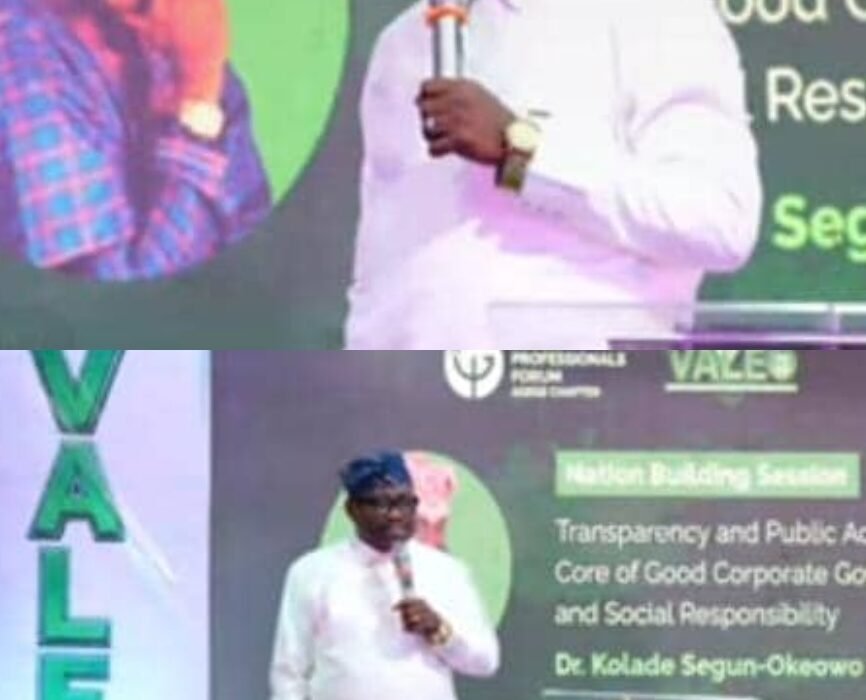
Dr Kolade Segun-Okeowo (KSO) has challenged Nigerian Christians and young professionals to participate actively in politics and the electoral process, warning that transparency and accountability cannot be achieved by remaining outside the system. Oluwaseyi Elizabeth Jimoh reports.
KSO CHALLENGES CHRISTIANS TO ENTER POLITICS, SAYS ACCOUNTABILITY REQUIRES PARTICIPATION
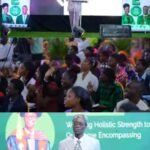
The room was lit up. The instrumentals were thrilling as the compere read the biography of the guest facilitating the political session at an event organised by the Young Professionals Forum, Agege Chapter.
It was another segment of the programme, and on the agenda was a nation building session— a subject that, for some members of the predominantly Christian audience, appeared at first to have little to do with them.But that perception soon began to change.
As the invited guest mounted the stage and began to facilitate the session, the chains that had clogged perception, tied decision-making and blurred vision appeared to loosen, as he took the participants through the topic, “Transparency and Public Accountability: Core of Good Corporate Governance and Social Responsibility.”
Drama evangelist and political leader, Dr Kolade Segun-Okeowo, popularly known as KSO, spoke extensively on governance, political participation, corruption and the role of Christians in Nigeria’s electoral process.
His introduction itself became part of the moment. Responding to the ear-deafening instrumentals and vibrant reading of his profile, KSO could only respond with a charming smile and a dramatic tone: “Paparazzi po.”
And perhaps, it was difficult to blame the professionals in the room. Some had seen the invited guest on their screens, but this time they had the opportunity to see him live, listen to the “real” KSO and glean from his wealth of experience.
KSO soon moved from humour to a question that struck at the heart of the mood in the country.
He asked the professionals in the room whether they would like to “japa”— leave Nigeria in search of opportunities elsewhere. Most responded in the affirmative.
He said the response was itself a reflection of the tragedy of a nation grappling with corruption and poor governance, adding that he was not casting blame on anyone.
He then asked why the change Nigerians desire has remained elusive. “We are not doing things differently. Things are not changing and we are expecting results to be different. Who wants different results while doing things the same way? he questioned.
‘YOU CANNOT TALK ABOUT ACCOUNTABILITY FROM OUTSIDE THE POLITICAL PROCESS’
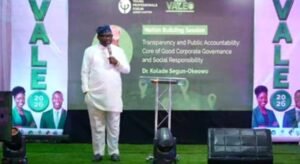
KSO described the political class as the controlling class, saying it is the class that dictates what happens in the country.
Speaking about the power of government, he declared: “Next to the power of God is the power of government.” He referenced Genesis 11 and the biblical account of the Tower of Babel, where people came together with a common purpose to build a tower that would reach the heavens.
KSO noted that despite the absence of modern technology at the time, God acknowledged the ability of the people to accomplish what they had collectively purposed to do.
He interpreted the biblical account as an illustration of the power that comes when people organise themselves under a common structure.
According to him, the moment a group of people says, “Come, let us,” it is taking hold of a collective power that he described as being next only to God.
“There is power in government,” he said, explaining that government controls the economy and virtually every aspect of human life.
“Government controls your life from the womb to the tomb. The day you are born, it is the government that agrees that you are born; the day you die, it is the government that says so. You ain’t married until government says you are married.”
He lamented that when the wrong people occupy positions of governance and make rules and regulations that affect the rest of society, tragedy becomes inevitable. He illustrated his concern with a personal political experience.
KSO recalled attending a manifesto where, according to him, a political aspirant publicly stated that he would support “maternal mortality” if elected. He said he was shocked not only by the statement but also by the fact that the aspirant eventually won the election.
For KSO, the incident demonstrated why young professionals must do more than complain about political leadership. They must participate in the process of restructuring the system.
He therefore took aim at professionals who limit their political participation to social media commentary. “Most of you sit down there and speak grammar on social media. You cannot talk about accountability and public transparency except you are involved in the process that brings people into governance,” he said.
‘THE PROBLEM WITH US CHRISTIANS IS THAT WE ARE NOT IN THE SYSTEM WE ARE TRYING TO CONTROL’

KSO turned to the biblical account of Esther to explain why participation and political platforms matter.
He asked the audience: “Who killed Haman?”
“If you say Esther, you are wrong,” he told them.
According to KSO, Mordecai was instrumental in bringing about Haman’s downfall because he understood how to use the political instrument represented by Esther.
He said Esther, the young woman in the palace, did not initially understand why she was there, but Mordecai recognised the importance of her position and challenged her to act.
He recalled Esther’s famous response: “If I perish, I perish.”
KSO argued that Esther’s accountability to Mordecai was connected to the political platform that had helped place her in a position of influence.
In his interpretation of the story, Mordecai had worked to create opportunities for Esther, including lobbying for the necessary political platform, producing campaign materials and engaging the head of the eunuchs on her behalf.
Therefore, when Esther eventually occupied the position, Mordecai had the standing to speak to her and challenge her to use that position for the good of her people.
It was this analogy that KSO used to challenge the Christian community.
“The problem with us Christians is that we are not in the system we are trying to control. We are not part of the system we are trying to correct. Standing outside and correcting from without won’t work,” he said.
He argued that the system would not listen to people who had refused to participate in it, adding that Christians must become part of the electoral process if they genuinely want to influence governance.
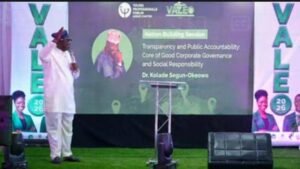
‘VOTES DON’T COUNT, BUT THEY BUY IT’
KSO also challenged Christians who stay away from politics because they believe their votes do not count.
He described the belief as a wrong perception that must change.
“If we have a country to fix, why will you see politicians desperate to go to any length to buy votes, while Christians won’t be involved because votes don’t count?” he asked.
Then came his punchline:
“Votes don’t count, but they buy it.”
He challenged the young professionals to ask themselves who was actually deceiving whom.
If politicians were willing to spend money to obtain votes, he argued, then the votes clearly had value.
KSO said part of the problem was ignorance and the tendency among some Christians to prevent their children from participating in politics because of the perception that politics is inherently corrupt.
That, he said, had contributed to the Christian community’s distance from political decision-making.
‘THERE IS MORE CORRUPTION IN CIVIL SERVICE THAN IN THE POLITICAL WORLD’
The political leader questioned the common preference among Christians for civil service over politics.
He said the average Christian was often comfortable encouraging their children to become civil servants because they had been taught that corruption was concentrated in politics.
He then delivered what he described as a shocker:
“There is more corruption in civil service than in the political world.”
He argued that politicians could not steal public money without the assistance or cooperation of civil servants because civil servants understand the system and know where government money is located.
According to him, the biggest corruption is perpetuated within the civil service.
He therefore challenged professionals to reconsider the assumption that entering politics automatically makes a person corrupt.
‘POLITICS IS NOT DIRTY; IT ONLY TAKES THE APPEARANCE OF THOSE PRACTISING IT’
KSO insisted that politics itself is not inherently dirty.
Rather, he argued, its reputation is shaped by the people who practise it.
“Politics is not dirty; it only takes the appearance of those practising it,” he said.
He urged professionals to pursue genuine accountability by becoming participants in the electoral process.
According to him, the belief that politics will automatically make someone corrupt is misplaced.
He argued that if a person is not corrupt before assuming political office, occupying a political position should not automatically make the person corrupt.
“You won’t be corrupted if you’re not corrupt,” he maintained.
Reflecting on his own political journey, KSO spoke about his experience as a chairman of the Peoples Democratic Party (PDP) in his local government.
He said financial records were kept during his tenure and that, by God’s grace, he was able to demonstrate financial transparency.
He subsequently asked the audience how many of them wanted to join politics.
Only a few hands went up.
KSO challenged those who showed interest to become politically educated and prepared.
He described what he considered one of the greatest tragedies in the attitude of Christians towards politics: rather than taking action and becoming involved, many simply talk and pray for the wrong set of leaders to emerge.
‘UNTIL WE START A PROCESS OF SUBSTITUTION BY ELIMINATION, THE SITUATION WILL REMAIN THE SAME’
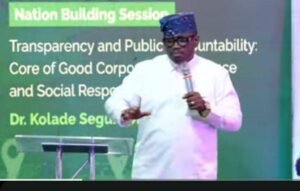
KSO said Nigeria’s political problems would persist until citizens began to replace ineffective leadership through deliberate political participation.
“Until we start a process of substitution by elimination, the situation will remain the same,” he said.
He described Nigeria as a country where politicians sometimes spend fortunes to secure political offices and are subsequently expected to treat those offices purely as public service.
For him, this creates a fundamental contradiction.
“It’s a contradiction because that is politics, and politics is an investment in our system. And until we change that narrative, forget transparency and accountability.”
He illustrated the problem by calculating how a particular political leader could allegedly spend about N1 billion before assuming office, despite earning approximately N20 million monthly.
Over four years, he said, such remuneration would amount to about N960 million.
KSO questioned the logic of spending about N1 billion to obtain an office whose official earnings over four years are less than the amount invested to secure it.
His argument was that the system itself creates incentives for corruption when political office is treated as an investment to be recovered.
“The system is wrong,” he said, arguing that until there is a fundamental change— which he described in strong terms as a revolution— Nigerians should not expect transparency and accountability to emerge simply by demanding them.
“Stop asking for accountability and transparency in the political space” until the underlying system is changed, he added.
‘WE ARE AGONIZERS WHEN WE SHOULD BE ACTORS’
The Drama Minister said Nigerians must become more proactive if they genuinely want to change the country.
He recalled an earlier address by Professor Joseph Afolayan, who, according to him, had described Africans as “agonizers”— people who complain and agonise over problems without necessarily taking action to resolve them.
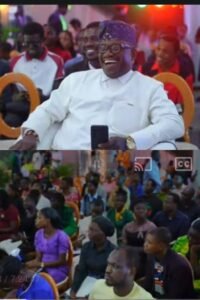
He charged the Christian community to develop a stronger sense of relevance, passion and responsibility towards governance.
According to him, politicians have successfully boxed Christians into the church by allowing them to focus almost exclusively on religious activities while leaving the political space to others.
‘THE PEOPLE IN GOVERNANCE MAY BE CHRISTIANS, BUT THEY ARE NOT CHRISTIAN CANDIDATES
KSO made a distinction between having Christians in government and having political candidates produced and supported by a Christian political platform.
“The people we have in governance may be Christians, but they are not Christian candidates,” he said.
According to him, a person may be a Christian occupying a political office without having been brought into that office through a platform controlled by Christians.
He referenced the excitement among Nigerian Christians when a former vice president rose into political office, arguing that many did not sufficiently understand the political platform that had produced him.
According to KSO, because the platform was not owned by those who supported him, those who controlled it could eventually withdraw or redirect it.
This, he said, explains why Christians must understand that having a Christian in office is not necessarily the same thing as having a political structure capable of producing, supporting and holding leaders accountable.
‘UNTIL WE HAVE MORDECAI, WE CANNOT HAVE ESTHER’
KSO returned to the story of Esther and Mordecai to reinforce his argument.
“Until we have Mordecai, we cannot have Esther!” he reiterated emphatically.
He asked whether Esther would have had the courage to approach the king if Mordecai had not first challenged her to understand the responsibility attached to her position.
According to KSO, Esther’s response to Mordecai was not based solely on her love for God but also on the political platform that had placed her in a position where her actions could influence the fate of her people.
He suggested that the response could have been different if another person without Mordecai’s relationship to the political process had approached Esther with the same request.
The lesson, he said, was that political influence requires a platform.
‘THERE IS CORRUPTION IN EVERY NIGERIAN’
Turning his attention to ordinary citizens, KSO argued that corruption should not be discussed only in relation to politicians.
“There is corruption in every Nigerian,” he said.
He explained that families, churches and communities often celebrate when someone close to them secures a political appointment.
But, according to him, the celebration can sometimes be driven by the expectation that the newly appointed public officer will provide personal benefits.
He said the mentality of seeking a share of the “national cake” had become deeply embedded in society.
KSO also criticised religious organisations that bombard politicians and public officers with personal demands once they gain access to them.
He questioned why citizens do not always demand answers about constituency projects and public expenditure.
Instead, he said, many people focus on what they can personally obtain from political leaders.
For KSO, this is another indication that corruption is not simply a problem of political office holders but a broader societal problem.
‘CHRISTIANS HAVE THE NUMBERS, BUT IT IS A FEARFUL NUMBER’
KSO also spoke about the gap between voter registration and actual voter participation.
He said some Christian groups mobilise members to obtain Permanent Voter Cards (PVCs), but those same members sometimes fail to turn up on election day.
He recounted the alleged experience of a political aspirant who had registered about 200,000 people and provided transportation to help them obtain their PVCs.
Yet, according to KSO, the turnout on election day was disappointing and the aspirant eventually lost.
He blamed what he described as the failure of the Christian community to follow through with its electoral participation.
“Incidentally, Christians have the numbers, but it’s a fearful number,” he said.
The numbers, he explained, are significant but become ineffective when people do not actually vote.
He argued that some political aspirants may genuinely intend to do well but can be frustrated when the people they expect to support them fail to participate on election day.
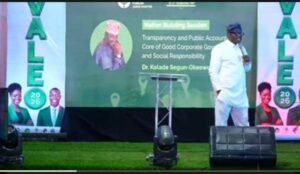
‘THE SYSTEM KNOWS OUR WEAKNESS’
KSO said the political system understands the weaknesses in Christian political participation and has learned to work around them.
According to him, Christians do not necessarily need to make noise about accountability; they need to change the system that produces political leadership.
He explained that the people Nigerians demand accountability from are themselves influenced by political structures and leaders at the ward level.
Therefore, demanding accountability only after leaders have assumed office may be too late.
The answer, he said, is to become involved before leaders emerge.
‘PENETRATE THE WARDS; POLITICIANS RESPECT NUMBERS’
KSO proposed that the Young Professionals Forum should consider penetrating the grassroots political structure by becoming active at the ward level.
He urged young professionals to become part of political parties and develop influence within their respective wards.
He described this as a way of building a political caucus capable of influencing the direction of governance.
“Politicians respect numbers,” he said. He therefore urged the professionals not to be in a hurry, stressing that political influence takes time to develop.
For him, anyone who genuinely wants accountability must first be willing to participate in the system from which they are demanding accountability.
“If we want true accountability, get involved in the system you are calling accountability from,” he urged.
‘THE REAL TROUBLES OF NIGERIA DON’T CONTEST ELECTIONS’
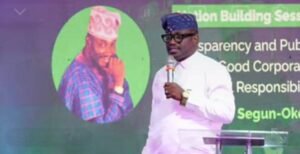
As he brought his session to a close, KSO made another striking observation:
“The real troubles of Nigeria don’t contest elections.”
He explained that some of the people who exert significant influence over governance may never appear on the ballot paper.
They may operate within political structures and networks, influencing decisions and determining outcomes without necessarily seeking elective office themselves.
KSO, however, maintained that transparency and accountability are possible in Nigeria’s governance and political systems.
The challenge, he said, is that there is a system that works against accountability.
And that system, he insisted, must be dismantled.
For the young professionals gathered at the Young Professionals Forum, Agege Chapter, the session had moved beyond a conventional discussion on transparency and public accountability.
It became a challenge to reconsider the place of Christians and young professionals in Nigeria’s political process.
KSO’s message was direct: Nigerians cannot remain outside the political system and expect to control it from the outside.
If the system is to change, he argued, those demanding change must be prepared to enter it, understand it, organise within it and gradually reshape it.
LEADERSHIP SUMMIT FOCUSES ON DEVELOPING FUTURE LEADERS
Earlier in his welcome address, Pastor Victor Owotowoseye described the leadership summit as a purposeful gathering designed to strengthen and inspire meaningful contributions from young professionals.
He said the world needs leaders who possess not only knowledge and competence but also character, courage, integrity, vision, resilience, emotional intelligence and the capacity to positively influence others.
“Leadership is not simply occupying a position but about accepting responsibility, providing direction, solving problems, developing people and creating a lasting impact,” he said.
Owotowoseye said the YPF seeks to shape the future through innovation, entrepreneurship, ideas and professionalism while helping participants develop the capacity to lead institutions, strengthen communities and contribute to national development.
The summit, themed “VALEO 2026: Fortifying Leaders with Strength for Global Exploit,” attracted professionals, entrepreneurs, graduates, academics and other stakeholders.
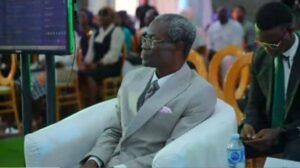
Among the dignitaries present was the Acting Vice-Chancellor of Landmark University, Professor Joseph Afolayan, who also addressed participants at the summit.