


NO WATER, NO FLOW: HOW A TEMPORARY OUTAGE BROUGHT ONE OF THE UK’S BUSIEST AIRPORTS TO A CRAWL

You don’t truly notice the value of running water until it stops flowing.
For several hours on Sunday, passengers at London’s Gatwick Airport—the UK’s second busiest aviation hub—found themselves in long queues outside toilets that would not flush, restaurants and bars that could not serve food, airport lounges that had shut their doors, and terminals where something as basic as washing hands became impossible.
Aircraft continued to take off and land, but inside the terminals, the temporary loss of running water exposed an often-overlooked truth: water is not just a basic human necessity—it is the lifeblood of modern transportation.
The disruption began after a power failure at SES Water’s Bough Beech treatment works cut water supply to both Gatwick terminals. The outage quickly rippled across airport operations, forcing the closure of many toilets, food outlets and hospitality facilities that depend on clean running water to meet hygiene standards.
As the queues grew longer, so did passengers’ frustration.
”For people who need to go to the toilet, this isn’t good,” passenger Paul Lee told the BBC, lamenting what he described as poor communication from the airport. He said he neither heard announcements nor saw the bottled water the airport said it was distributing. “I’m taking off soon, so that’s fine, but for passengers in a few hours, this will be bad.”

For Sarah Houchin, whose flight to Greece was delayed by nearly two-and-a-half hours, the breakdown in sanitation became impossible to ignore.
”The toilets are either closed or they send you to another toilet and it’s a really long queue,” she said. “The toilets are disgusting. As you can imagine, you can smell them.”
Roger Wood, who arrived at Gatwick expecting a routine journey, instead found restaurants and bars shuttered because there was no fresh water for food preparation or handwashing.
Wood said people could go in the toilets but there was no way to wash hands and conditions had grown worse in the hour or two they were there.
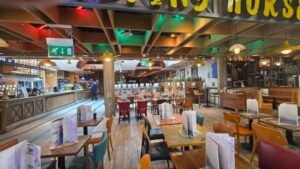
”There was no Nando’s, no Wetherspoon—all of those places were completely shut,” he said. Only outlets selling packaged food remained open, while travelers resigned themselves to an uncomfortable wait.
Others complained that families were left sitting on terminal floors after restaurants and lounges closed. Former MP Michael Dugher questioned why passengers were not even allowed to use the empty chairs inside the closed restaurants, saying, “No water is one thing, but depriving people of somewhere to sit is another.”

The water outage also affected airport operations. BBC reporter Adam Dowling, travelling into Gatwick from Valencia, said passengers were informed that landing slots were being adjusted to reduce the number of incoming flights, resulting in delays. EasyJet also altered its baggage-drop schedule, asking passengers not to arrive earlier than necessary to ease congestion. Gatwick said no flights were cancelled because of the incident.
Airport authorities apologised for the disruption, deployed additional staff across both terminals, handed out bottled water and worked with SES Water to restore services. By Sunday night, Gatwick said water had returned to “the vast majority” of the airport campus, while SES Water described the incident as a “highly unusual and complex” failure caused by a power outage at its treatment works.
Beyond the airport, the disruption extended to homes and businesses across parts of Kent, Surrey and south London, where customers experienced low water pressure or temporary loss of supply. SES Water said bottled water was being delivered to vulnerable customers as engineers worked to stabilize the network.
Although temporary, the incident demonstrated how deeply transportation systems depend on reliable water infrastructure.
Running water keeps toilets operational, enables hand hygiene, supports food preparation, maintains hospitality services and allows millions of passengers to move through airports safely and comfortably.
When that single service failed, the consequences spread across every layer of airport operations.