
WHO ATTACKS JOURNALISTS MOST DURING NIGERIAN ELECTIONS? IPC DIRECTOR REVEALS WHAT WSCIJ REPORT SHOWS
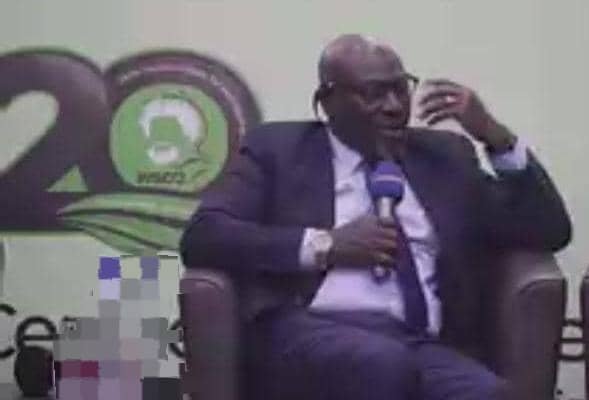
IPC Director Lanre Arogundade reveals the major actors behind attacks on journalists during Nigerian elections as WSCIJ’s 2025 report highlights growing threats to press freedom and shrinking civic space. Oluwaseyi Elizabeth Jimoh reports
IPC DIRECTOR REVEALS WHO ATTACKS JOURNALISTS MOST AS WSCIJ REPORT WARNS OF SHRINKING CIVIC SPACE
Journalists covering elections in Nigeria are more likely to be attacked by political party agents and politicians’ supporters than by security personnel, says the Executive Director of the International Press Centre (IPC), Mr Lanre Arogundade.
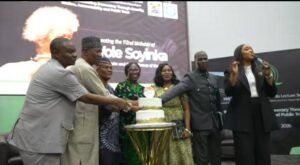
Arogundade made the remarks during the 18th Wole Soyinka Centre Media Lecture Series and the public presentation of the 2025 Journalism and Civic Space Status Report, organised by the Wole Soyinka Centre for Investigative Journalism (WSCIJ) at Providence Hotel, GRA, Ikeja, Lagos.
Responding during a panel session, Arogundade said the IPC’s documentation of attacks on media professionals shows that political actors remain the leading perpetrators during election periods.
“Most of the attacks witnessed by journalists occurred while covering elections, and most were carried out not by security personnel or the police but by party agents working with politicians,” he said.
WSCIJ Report Highlights Shrinking Civic Space
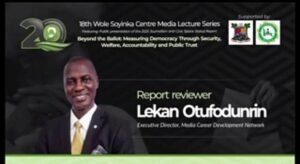
The 2025 Journalism and Civic Space Status Report, titled Silenced Voices, Shrinking Space: Civic Freedoms Under Pressure, was reviewed by media career development specialist Lekan Otufodunrin.
The report analyses civic space violations in Nigeria between January and December 2025 and concludes that civic freedoms remain under significant pressure despite constitutional guarantees and democratic governance.
According to the report, journalists, media organisations, activists and citizens expressing political, governance or social views were among the groups most affected.
However, it notes a significant shift from previous years, with incidents involving ordinary citizens increasing sharply in 2025.
While journalists were the most affected group in 2024, the report says the rise in citizen-related incidents suggests that restrictions are extending beyond the media to broader civic participation and democratic engagement.
Geographically, Abuja and Lagos accounted for the highest number of documented incidents, reflecting their roles as centres of governance, media activity, economic operations and political mobilisation.

The report cautions that lower figures recorded in some states should not automatically be interpreted as evidence of greater freedom, noting that under-reporting, limited documentation and media constraints may conceal the true scale of violations.
Explaining the findings, Otufodunrin said some incidents never entered the report because affected journalists chose not to report them.
“You can’t invent what was not reported,” he said.
He explained that the report relied on documented records and publicly available information and therefore could not assess incidents that were never formally reported.
The report recommends stronger protection of civic space through sustained reporting, improved documentation, legal support mechanisms, strategic advocacy and closer collaboration among media organisations, civil society groups and professional associations.
Otufodunrin commended WSCIJ for consistently documenting civic rights violations.
“People often ask whether democracy has improved freedom. Reports like this provide the evidence policymakers, the judiciary and other stakeholders need because civic freedom is fundamental to democracy,” he said.
During a panel discussion, Otufodunrin said the democratic environment has not produced the level of press freedom many expected.
He argued that some journalists now avoid reporting attacks because of fear of losing their jobs, while others work in environments where media organisations discourage such reporting.
He also cited poor remuneration, widespread freelance employment and financial dependence on government institutions as factors limiting journalists’ willingness to report abuses.

Key findings of the report
The report documented 245 civic rights incidents referenced across 570 media reports published by 54 media organisations.
Among its findings:
219 incidents (89%) involved state actors, while 26 incidents involved non-state actors.
The Nigeria Police Force accounted for 118 of the 219 incidents involving state actors, representing 54% of state-related cases.
145 incidents involved non-violent measures, including arrests, summons, detention, legal actions and regulatory sanctions.
100 incidents involved violence, including threats, intimidation, harassment, physical assault and destruction of property.
The report concludes that restrictions on civic freedoms are increasingly being enforced through administrative and institutional mechanisms that may attract less public attention but can have equally serious consequences.
Umaru Pate calls for stronger protection of journalists
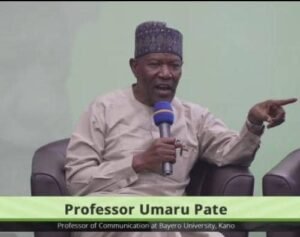
Professor of Communication at Bayero University, Kano, Umaru Pate, said the report should be used to strengthen advocacy aimed at policymakers, media owners and professional bodies.
He argued that journalists face multiple forms of insecurity, including psychological, economic, digital and gender-related risks, many of which receive little attention.
Pate criticised poor remuneration and weak labour protections within the media industry, saying many journalists endure unpaid salaries and exploitative working conditions because of widespread unemployment.
He urged professional associations to document abuses more consistently, pursue legal action where necessary and advocate for better welfare standards.
Journalism education must evolve
Speaking on journalism education, Pate said Nigeria’s communication and media studies curriculum had already been revised to reflect emerging global realities.
He noted that new courses such as media economics, conflict and security reporting and digital journalism had been introduced through curriculum reforms aligned with UNESCO standards.
However, he argued that the greatest challenge now lies with educators.
“Our lecturers are our greatest challenge today, not even our students. Many of our students are better equipped in computer skills and modern thinking than some lecturers who are still teaching journalism as it was decades ago,” he said.
Pate called on institutions, including the Wole Soyinka Centre, to deepen engagement with journalism educators to ensure graduates are equipped with practical digital, entrepreneurial and safety skills required in today’s media landscape.

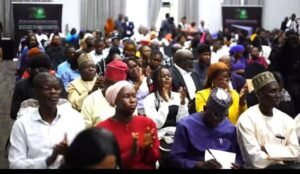
The panel session moderated by Arise News journalist Ayo Mairo-Ese and attracted participants from across the media, academia, civil society and policymaking community.
The event also coincided with the birthday of Nobel Laureate, playwright and civic advocate Professor Wole Soyinka, after whom the Centre is named. Coincidentally, Mr Lanre Arogundade, Executive Director of the International Press Centre, shares the same birth date—July 13.